







Section 179 tax deduction on a commercial Ram truck or van in California
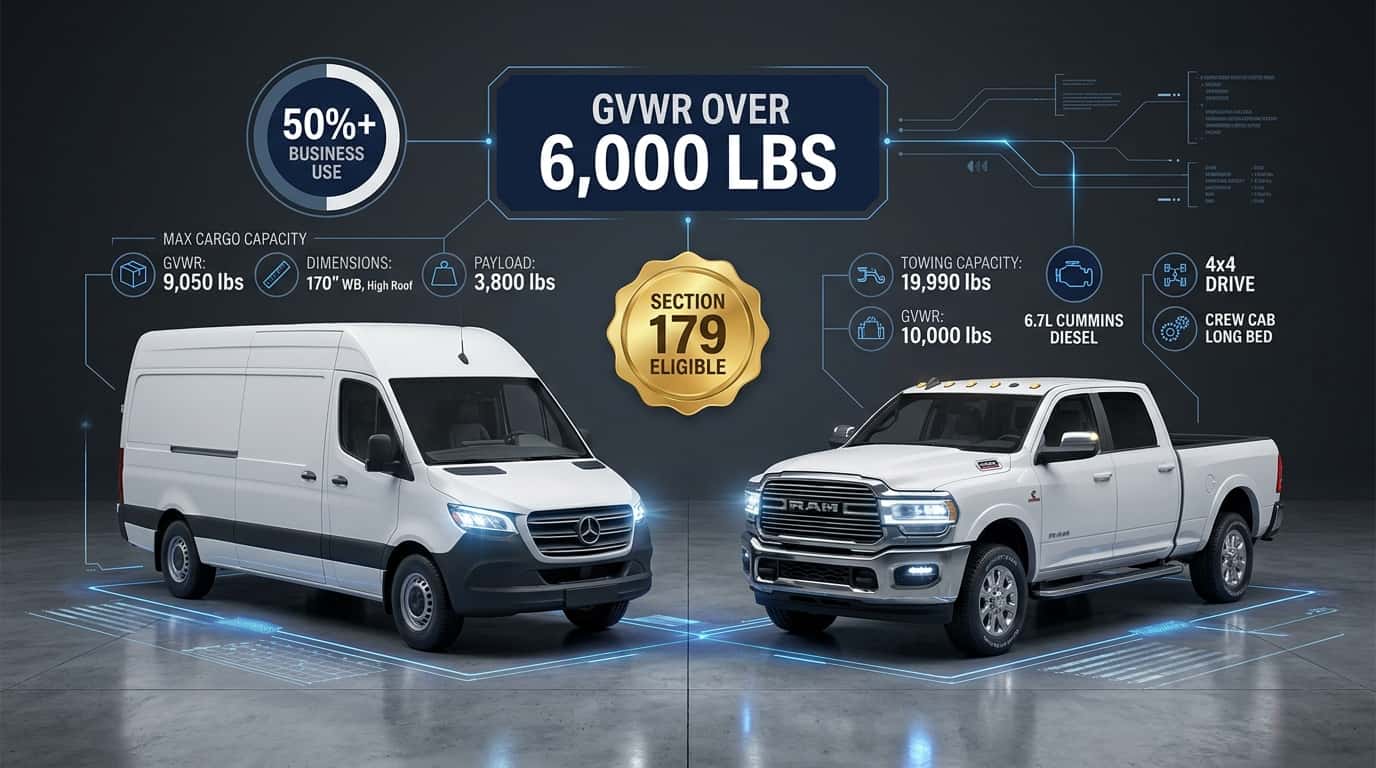
To qualify for a Section 179 tax deduction on a commercial Ram truck or van in California, the vehicle must have a Gross Vehicle Weight Rating exceeding 6,000 pounds, be purchased or financed and placed in service during the tax year, and be used more than 50% for business operations. Qualifying models include heavy-duty pickups and full-size cargo vans. Federal expensing allows up to $2,560,000 for 2026, though California state tax rules cap state-level Section 179 expensing at $25,000.
Business owners evaluating new fleet additions can review physical weight ratings and vehicle specs at our Ventura showroom address or connect with our commercial sales team directly at (805) 918-4486 to confirm inventory availability before year-end tax deadlines.
Which Commercial Ram Vehicles Qualify for Section 179 First-Year Deductions?
Commercial Ram models with a Gross Vehicle Weight Rating over 6,000 pounds qualify for accelerated Section 179 tax treatment when put to business use. Eligible vehicles in our commercial lineup include most configurations of the 2026 RAM 1500 Tradesman Crew Cab and Quad Cab, the heavy-duty 2026 RAM 2500 Tradesman, and the full-size 2026 RAM ProMaster Cargo Van.
The 6,000-pound Gross Vehicle Weight Rating threshold serves as the boundary between standard passenger automobiles and heavy commercial vehicles under Internal Revenue Code Section 179. Vehicles with a weight rating under 6,000 pounds are subject to passenger car depreciation limits, which cap first-year write-offs at $20,200 for 2026. Vehicles exceeding 6,000 pounds Gross Vehicle Weight Rating escape those restrictive caps, unlocking substantial first-year tax expensing.
- 2026 RAM 1500 Tradesman: Quad Cab and Crew Cab 4×4 models exceed the 6,000-pound weight rating threshold. Light-duty regular cab 4×2 models often fall below 6,000 pounds Gross Vehicle Weight Rating, making body configuration an essential detail when shopping for tax-eligible light trucks.
- 2026 RAM 2500 Tradesman: Heavy-duty trucks carry weight ratings well above Class 2b requirements. Equipped with a standard 6.4L HEMI V8 or an available 6.7L Cummins Turbo Diesel engine, these trucks qualify for maximum federal first-year expensing options.
- 2026 RAM ProMaster Cargo Van: As a dedicated commercial vehicle featuring an enclosed cargo bay and no seating behind the driver, the ProMaster van is classified as a qualified non-personal use vehicle, making it an ideal choice for trade fleets.
Business buyers comparing truck configurations on our sales floor frequently ask whether a crew cab pickup qualifies identically to a cargo van. While both pass the 6,000-pound weight threshold, heavy SUVs and pickups with cargo beds under 6 feet face a separate federal Section 179 limit of $32,000 for 2026 unless fitted with a full-size bed or permanent commercial equipment, whereas enclosed cargo vans bypass the SUV cap completely.
In Camarillo, where agricultural operators and trade contractors transport heavy equipment across valley job sites, selecting a heavy-duty pickup or cargo van with sufficient payload capacity meets both daily job demands and federal tax qualifications. Prospective buyers can explore our broad inventory of new Ram trucks and vans or view pre-owned commercial options through our pre-owned commercial vehicle inventory to find eligible models in stock.
Table of Contents
- How Do California Tax Rules Differ From Federal Section 179 and Bonus Depreciation?
- Does Commuting Count Toward the 50% Business Use Requirement and What Documentation Is Needed?
- Common Questions Regarding Commercial Ram Tax Write-Offs in California
- Explore Commercial Ram Inventory for Your Business Needs
How Do California Tax Rules Differ From Federal Section 179 and Bonus Depreciation?
California tax law does not conform to federal Internal Revenue Code provisions for Section 179 limits or bonus depreciation. Federal tax law allows a 2026 Section 179 expensing cap of $2,560,000 alongside 100% federal bonus depreciation for qualified property, whereas the California Franchise Tax Board limits state Section 179 deductions to $25,000 and completely disallows bonus depreciation.
Because of this state-level divergence, business owners filing California tax returns experience a multi-year depreciation variance between their federal and state filings. Reconciling these amounts requires specific state schedules during tax preparation:
- Federal Section 179: The maximum expensing allowance is $2,560,000 for 2026, with a phase-out threshold beginning when total qualifying equipment placed in service exceeds $4,090,000.
- California Section 179: The Franchise Tax Board caps annual Section 179 expensing at $25,000, with a state phase-out beginning at $200,000 of total equipment purchases.
- Bonus Depreciation: Federal rules allow 100% bonus depreciation on remaining vehicle basis after Section 179 expensing, while California disallows bonus depreciation entirely.
- State Reconciliation Forms: California tax filers must submit FTB Form 3885 (for corporations) or FTB Form 3885A (for individuals and pass-through entities) to calculate and report the state-to-federal depreciation adjustment.
While a commercial truck purchase provides a significant immediate tax write-off on federal returns, the California state deduction is recognized primarily through standard multi-year state depreciation schedules. Commercial buyers planning a vehicle acquisition can begin structuring their vehicle purchase by evaluating your trade-in value online to offset upfront capitalized costs.
Does Commuting Count Toward the 50% Business Use Requirement and What Documentation Is Needed?
Standard commuting between a personal residence and a primary place of business is categorized by the IRS as personal travel and does not count toward the 50% business use requirement. Business owners must maintain contemporaneous mileage records and establish a clear placed in service date to defend their Section 179 tax deductions.
To claim Section 179, a commercial vehicle must be operated more than 50% for qualified business tasks during the tax year. Travel from a main office to customer sites, vendor locations, or job assignments qualifies as business mileage, but travel from home to a primary office does not.
- Contemporaneous Mileage Log: Documenting total odometer readings, dates, trip destinations, and exact business purposes via a paper log or mobile tracking app.
- Placed-in-Service Evidence: Retaining delivery receipts and work logs confirming the vehicle was actively deployed for business operations on or before December 31.
- Purchase and Title Records: Maintaining official bill of sale documents, registrations, and commercial loan contracts under the legal business entity name.
If business usage drops to 50% or below in any subsequent tax year during the vehicle’s standard depreciation life, IRS rules trigger depreciation recapture. The excess Section 179 benefit previously claimed must be reported as ordinary income on IRS Form 4797.
For service fleets operating along the flat coastal plain in Oxnard, routing commercial vans directly from customer service locations to regional job sites establishes clear, auditable business mileage records. Business managers ready to expand their commercial fleet can initiate financing steps by completing an online credit application prior to scheduling vehicle delivery.
Common Questions Regarding Commercial Ram Tax Write-Offs in California
Q: Does the Ram 1500 REV commercial electric truck qualify for Section 179 expensing?
The Ram 1500 REV commercial electric pickup carries a Gross Vehicle Weight Rating over 6,000 pounds, making it eligible for federal Section 179 write-offs based on its documented business use percentage. Although federal clean vehicle tax credits under IRC 30D and 45W ended for vehicles acquired after September 30, 2025, commercial electric pickups remain eligible for standard heavy-vehicle tax depreciation methods.
Q: How do commercial upfits and utility body modifications affect vehicle eligibility?
Adding permanent commercial equipment—such as utility service bodies, ladder racks, permanent toolboxes, or commercial enclosures—classifies a Ram vehicle as a qualified non-personal use vehicle. This classification exempts the truck from restrictive passenger car limits and the heavy SUV cap, enabling businesses to expense qualified upfits alongside the base vehicle under federal Section 179 guidelines.
Q: Can passenger-oriented vans like the Ram ProMaster Window Van qualify for Section 179?
The Ram ProMaster Window Van qualifies for Section 179 expensing if its Gross Vehicle Weight Rating exceeds 6,000 pounds and business use exceeds 50%. Vans configured to seat more than nine passengers behind the driver or vehicles used primarily for non-commercial passenger transportation are reviewed under separate passenger transport depreciation rules.
Q: Can I switch from actual expense depreciation to the standard mileage rate in later years?
Electing Section 179 or accelerated depreciation in the first year locks the vehicle into the actual expense method for its entire operational lifecycle. Business owners cannot switch a vehicle to the IRS standard mileage rate in subsequent tax years once accelerated depreciation has been claimed on that asset.
Q: What happens if I purchase a commercial truck late in the calendar year?
The IRS requires the vehicle to be placed in service before December 31 of the tax year. Signing a purchase contract or placing a deposit before year-end is not sufficient if physical delivery and active deployment into business operations do not occur within that same tax year.
Explore Commercial Ram Inventory for Your Business Needs
Selecting the right commercial truck or cargo van requires balancing gross vehicle weight ratings, payload demands, and tax qualification deadlines. Our commercial sales specialists at Crown Dodge Chrysler Jeep RAM walk business owners through exact weight specifications, available bed lengths, and commercial upfit options to match individual business goals.
Visiting our showroom allows fleet managers to compare trim packages, evaluate towing specifications, and confirm placed-in-service timelines ahead of tax deadlines. Stop by our Ventura dealership showroom at 6300 King Dr, Ventura, CA 93003 or give our commercial vehicle team a quick call at (805) 918-4486 to discuss current commercial truck availability and schedule a test drive.
Keep Your Vehicle Running Strong
Keep your vehicle performing at its best with our service team:
© 2026 Crown Dodge Chrysler Jeep RAM. All rights reserved.
0 comment(s) so far on Section 179 tax deduction on a commercial Ram truck or van in California