






Maintaining Stopping Power on Ventura Roads: Ram Brake Service Essentials
Maintaining Stopping Power on Ventura Roads: Ram Brake Service Essentials
Stopping a heavy-duty truck requires immense friction and heat management, especially when navigating the diverse terrain of the Central Coast. Whether you are hauling gear to a job site or towing a trailer over the Conejo Grade, your braking system is the most critical safety feature on your vehicle. Our team of certified technicians understands the specific engineering behind the 2026 RAM 1500 and its heavy-duty counterparts, ensuring that every pad, rotor, and caliper meets factory specifications for performance and reliability.
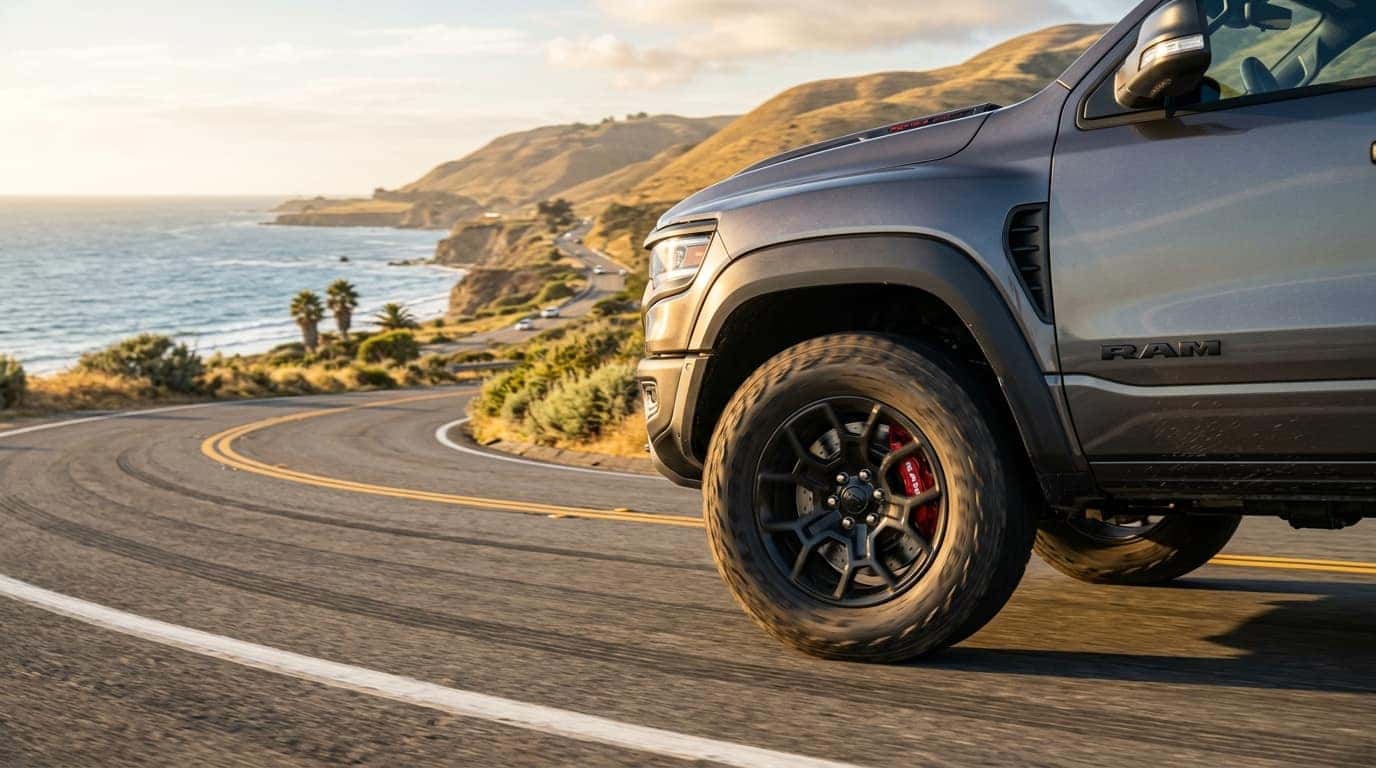
Maintaining these systems involves more than just swapping out worn parts; it requires a comprehensive understanding of how different trims and packages interact with the road. For instance, the 2026 RAM 1500 RHO utilizes a High-Output 3.0L Hurricane engine producing 540 hp, which places significant demand on the braking system during spirited driving. Similarly, the 2026 RAM 2500 features larger rotors and calipers designed for higher thermal capacity, allowing it to maintain stopping power under the heavy loads common for local contractors and tradespeople.
If you notice a soft pedal, high-pitched squealing, or a steering wheel vibration while slowing down, it is time for a professional evaluation. You can reach our service department by giving us a call at (805) 918-4486 to discuss your concerns or ask about current maintenance intervals. For those who prefer to plan ahead, our online service scheduler makes it easy to find a time that fits your busy workday. If you are already on the road, our Ventura service center is conveniently located to provide quick turnarounds and expert care backed by genuine parts.
Table of Contents
- How Often to Inspect and Service Your Ram Truck Brakes
- The Coastal Effect: How Ventura Salt Air Impacts Rotors and Calipers
- Brake Fluid Replacement Intervals for Hard-Working Trucks
- Electronic Calipers and Activating 2026 Ram Brake Service Mode
- Common Questions About Ram Braking Systems and Maintenance
How Often to Inspect and Service Your Ram Truck Brakes
How long should your brake pads actually last? In the world of full-size pickups, there is no fixed mileage interval for replacement because wear is entirely dependent on how you use the truck. A driver frequently commuting through the stop-and-go traffic of Oxnard will naturally go through brake linings faster than someone who spends most of their time on the open highway. Because of this variability, the 2024 Ram 1500 owner’s manual specifies that brake linings and parking brake operations must be inspected at every single oil change interval.
During these inspections, our technicians look for several key indicators of health:
- Pad Thickness: We measure the remaining friction material to ensure it is above the minimum safety threshold.
- Rotor Condition: We check for “scoring” (grooves), heat spots, or warping that causes pedal pulsation.
- Caliper Function: We ensure the pistons are retracting properly and the slide pins are well-lubricated.
- Hardware Integrity: We inspect clips and springs that prevent “brake drag” and annoying rattles.
The NHTSA recommends a full brake system inspection at least once a year, but for trucks used for heavy hauling or towing, we suggest a more frequent cadence. For example, the 2026 RAM 2500 often works in demanding environments where the brakes convert massive amounts of kinetic energy into heat. Over time, this heat can crystallize the surface of the pads, leading to decreased “bite” even if the pads still have plenty of thickness left. Regular check-ups allow us to catch these issues before they turn into expensive rotor replacements.
The Coastal Effect: How Ventura Salt Air Impacts Rotors and Calipers
Living near the Pacific Ocean provides a beautiful backdrop, but the salt-laden air is a constant adversary for automotive metals. While many owners worry about paint or chrome, the braking system is often the first place where salt-induced corrosion takes hold. Because brake rotors are made of cast iron and are not painted on the friction surface, they can develop “flash rust” overnight in our humid coastal environment. While a quick drive usually wipes this off, consistent exposure can lead to deeper pitting and edge corrosion.
This oxidation does more than just make the wheels look untidy; it can affect the mechanical movement of the calipers. In a coastal city like Ventura, salt can work its way into the caliper slide pins and piston boots. If these components become seized or “sticky,” the brake pads may stay in light contact with the rotor even after you lift your foot off the pedal. This leads to premature wear, reduced fuel efficiency, and excessive heat buildup.
We often see trucks where the inner pad is worn down to the metal while the outer pad looks nearly new—a classic sign of a seized caliper slide pin caused by environmental corrosion. During our standard brake service, we take the extra step to clean the hub surfaces and apply specialized high-temperature lubricant to all moving contact points. This extra layer of protection is essential for vehicles that spend their lives parked near the shore, ensuring the mechanical components move freely despite the salty breeze.
Brake Fluid Replacement Intervals for Hard-Working Trucks
When was the last time you thought about your brake fluid? Most drivers overlook this critical hydraulic fluid, yet it is the lifeblood of your stopping power. Brake fluid is “hygroscopic,” meaning it naturally absorbs moisture from the air over time. In a heavy-duty application like a RAM 2500 Limited, moisture in the fluid is dangerous because it lowers the boiling point. Under the high heat of heavy braking, moisture can turn into vapor, creating a “spongy” pedal feel and potentially leading to a total loss of braking pressure.
Ram guidelines state that brake fluid should be replaced every 3 years, regardless of how many miles you have driven. This interval is strictly time-based because the fluid absorbs moisture even when the truck is sitting in the driveway. Replacing the fluid also helps protect the expensive internal components of your Anti-lock Braking System (ABS) and Electronic Stability Control (ESC) from internal corrosion caused by contaminated fluid.
To maintain the integrity of your hydraulic system, we exclusively use genuine Mopar parts and fluids that are chemically engineered for your specific model year. Using the correct DOT-rated fluid ensures that the seals in your master cylinder and calipers stay supple and leak-free. If you are unsure when your fluid was last exchanged, our technicians can perform a quick moisture-strip test during your next tire rotation to determine if a flush is necessary.
Electronic Calipers and Activating 2026 Ram Brake Service Mode
Modern trucks have evolved far beyond simple mechanical linkages, and the 2026 RAM 1500 features an electronic parking brake (EPB) that requires a specific procedure during service. Unlike older trucks with a foot pedal and a cable, the new system uses electric motors mounted directly on the rear calipers to lock the wheels. If a technician tries to manually compress the caliper piston without first retracting the electronic actuator, it can cause permanent damage to the motor assembly.
To perform rear brake work safely, the vehicle must be placed into “Brake Service Mode.” This is typically handled through the Uconnect infotainment screen or a specific sequence of button presses and pedal holds. Once activated, you will hear the electric motors hum as they fully retract the parking brake screw. This clears the way for the piston to be pushed back so new, thicker pads can be installed.
This technology is standard across most trims, from the value-focused RAM 1500 Express to the luxury-oriented Tungsten. After the mechanical work is finished, the service mode must be deactivated to “re-zero” the calipers, allowing the computer to learn the new pad thickness and ensure the parking brake applies the correct amount of tension. Because this involves the vehicle’s computer systems, having this work performed by factory-trained experts ensures that your electronic safety systems remain perfectly calibrated.
Common Questions About Ram Braking Systems and Maintenance
Navigating the maintenance needs of a modern truck can be complex, especially with the introduction of new powertrains and electronic systems. Our service team is here to provide clear, practical answers to keep your vehicle in top shape.
Q: How do I know if I need new rotors or just new pads? If you feel a pulsating or “shuddering” sensation through the brake pedal when slowing down from highway speeds, your rotors are likely warped or have uneven pad deposits. While pads are the primary wear item, rotors must be measured for thickness and “run-out” to determine if they can be resurfaced or if they require full replacement.
Q: Does the 2026 RAM 1500 powertrain warranty cover brake components? The new 10-year / 100,000-mile powertrain warranty for the 2026 model year is designed to cover the engine, transmission, and drive systems. Brake pads, rotors, and shoes are considered “wear items” and fall under the 3-year / 36,000-mile Basic Limited Warranty, though they are typically only covered for defects in materials or workmanship rather than normal frictional wear.
Q: Why do my brakes squeal in the morning but stop after a few blocks? In our coastal climate, a thin layer of surface oxidation can form on the rotors overnight due to high humidity. The first few stops of the morning act as a cleaning cycle, grinding away that light rust. If the squealing persists throughout the day, it usually indicates that the wear sensors are making contact, signaling that your pads are nearly exhausted.
Q: Is there a difference in brake service for the RAM 1500 vs the RAM 2500? Yes, the RAM 2500 uses a much larger braking system with heavy-duty calipers designed for the heat generated by towing up to 20,000 pounds. The parts are physically larger and the torque specifications for the lug nuts and caliper bolts are significantly higher, requiring specialized heavy-duty shop equipment.
Q: Can I wait until the brake warning light comes on to book service? Not all trucks are equipped with electronic pad wear sensors that trigger a dashboard light. Most rely on a mechanical “chirper”—a small metal tab that scrapes the rotor to make noise when the pads are low. Waiting for a light or a loud grinding noise can lead to “metal-on-metal” contact, which destroys the rotors and significantly increases your repair costs.
If you have more questions or need a professional inspection, you can find our Ventura location on King Drive. For immediate assistance with scheduling or parts availability, please give our team a quick call so we can help you get back on the road safely.
© 2026 Crown Dodge Chrysler Jeep RAM. All rights reserved.
0 comment(s) so far on Maintaining Stopping Power on Ventura Roads: Ram Brake Service Essentials