






Professional Jeep Brake Service in Ventura California
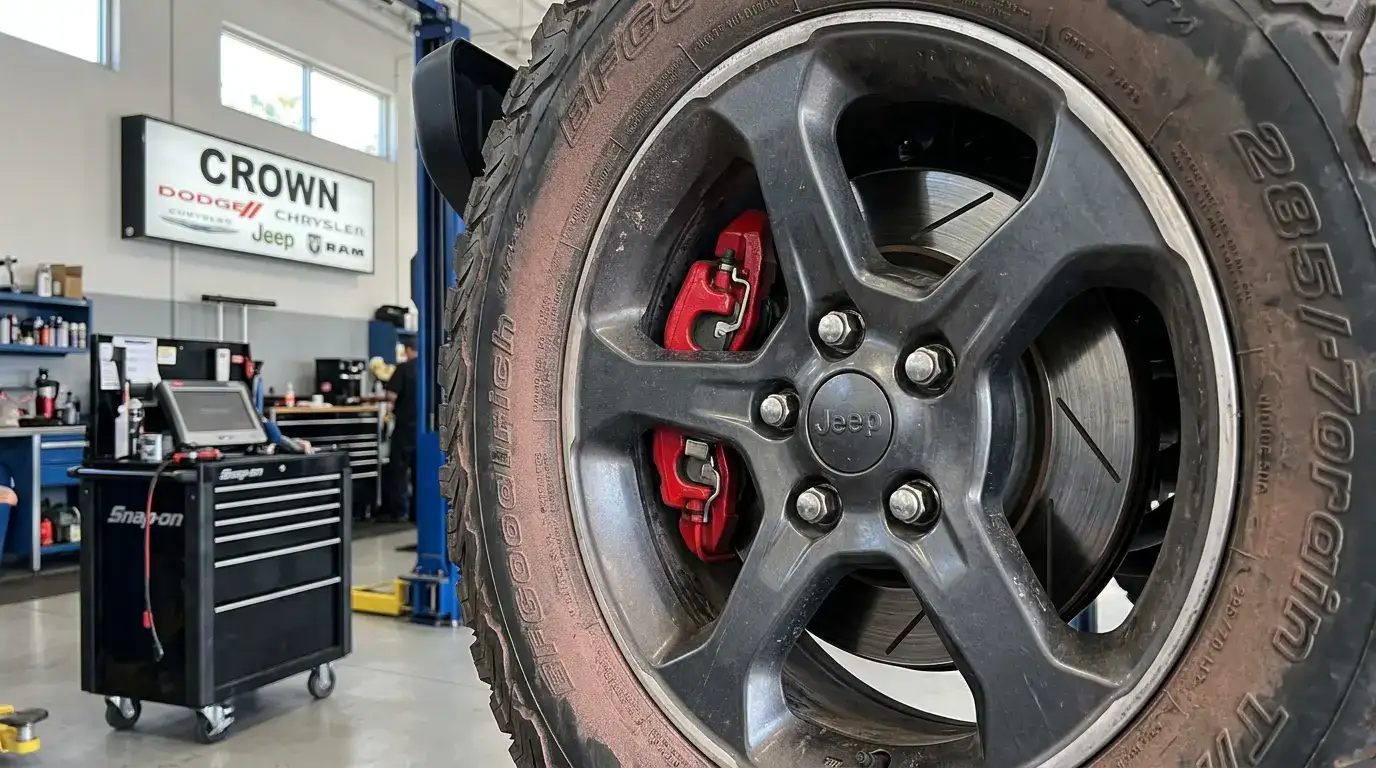
Maintaining the stopping power of your vehicle is the single most critical safety measure you can take as an owner. The braking system on your Jeep is engineered to handle everything from daily highway commutes to demanding off-road trails. To keep these components operating at peak efficiency, the manufacturer recommends having a comprehensive brake inspection at least every 12,000 miles or once per year. Regular inspections allow factory-trained technicians to identify minor wear before it develops into a costly mechanical failure or compromises your safety on the road.
Vehicles that are frequently driven under severe conditions require more frequent attention. If you regularly use your vehicle for heavy towing or spend weekends exploring dusty, muddy, or sandy trails, scheduling a professional inspection every six months is highly recommended. A typical multi-point inspection at our dealership includes measuring brake pad thickness, checking rotor surfaces for heat damage or grooving, inspecting caliper operation, and testing the moisture content of the brake fluid.
When your vehicle requires professional attention, choosing a specialized facility ensures your vehicle receives the exact care it needs. Our team of certified technicians possesses deep, brand-specific expertise and utilizes state-of-the-art diagnostic equipment designed specifically for your vehicle’s systems. If you notice a change in pedal feel or stopping distance, you can quickly book an appointment using our online service scheduler to have our team perform a thorough diagnostic.
For drivers seeking dependable maintenance, our modern facility is conveniently located at 6300 King Drive, Ventura, CA 93003. If you need to speak directly with a service advisor regarding a specific braking symptom or wish to coordinate a drop-off time, you can reach our service department by giving us a quick call. For turn-by-step navigation to our service bays, you can easily get directions to our dealership and visit our team today.
Table of Contents
- How Often Should You Flush the Brake Fluid on a Jeep?
- What Do Squealing or Grinding Noises From My Jeep’s Brakes Usually Mean?
- How Much Does a Full Jeep Brake Job Cost Including Rotors?
- Which 2026 Jeep Models Come Standard With Heavy-Duty Brakes?
- Does a Standard Brake Service Affect the Jeep Active Braking Sensor System?
- What Advantages Does a Professional Jeep Brake Service Have Over DIY Work?
- Common Questions About Maintaining Your Jeep Braking System
How Often Should You Flush the Brake Fluid on a Jeep?
Brake fluid is a specialized hydraulic fluid that transfers the physical force of your foot on the pedal directly to the brake calipers at the wheels. Over time, this fluid naturally absorbs moisture from the surrounding atmosphere through microscopic pores in the rubber hoses and seals. This moisture accumulation is problematic because it lowers the boiling point of the fluid, which can lead to a spongy pedal feel and reduced stopping capability under heavy braking. Furthermore, moisture inside the hydraulic lines promotes internal corrosion, which can damage expensive components like the master cylinder and anti-lock braking system valves.
To prevent these issues, factory maintenance schedules recommend a complete brake fluid flush every two years or approximately 20,000 to 30,000 miles. During this service, the old, contaminated fluid is completely drained from the entire system, the lines are flushed, and fresh fluid is added and bled to ensure no air bubbles remain. Service advisors also recommend checking the fluid level and inspecting for clarity during every routine oil change to catch potential leaks or rapid degradation early.
Using the correct fluid specification is essential to maintain the integrity of your hydraulic system. Different models and model years require specific formulations, such as DOT 3 or DOT 4 fluid, which should never be mixed. Our parts department stocks a complete inventory of genuine Mopar parts and accessories, ensuring that any fluid exchange or component replacement performed on your vehicle utilizes the exact manufacturer-approved formulas designed for your specific model.
What Do Squealing or Grinding Noises From My Jeep’s Brakes Usually Mean?
Are your brakes trying to tell you something? Auditory warning signs are often the first indicator that your braking system requires immediate professional attention. Ignoring these sounds can turn a simple maintenance task into an expensive, extensive mechanical repair. Understanding what these specific noises mean can help you make informed decisions about your vehicle’s maintenance needs.
A high-pitched squealing or screeching sound when you apply the brakes is usually caused by a built-in mechanical wear indicator. This indicator is a small metal tab attached to the brake pad backing plate. When the friction material wears down to a critical thickness—typically around 3mm—this metal tab makes contact with the spinning rotor, creating a persistent squeal. This is an intentional safety feature designed to warn you that your brake pads are nearing the end of their usable life and need to be replaced soon. Squealing can also occasionally be caused by glaze on the pads or moisture build-up, but a professional inspection is required to confirm the cause.
A harsh, metallic grinding noise is a far more urgent warning sign. This sound typically indicates that the brake pads have worn down completely, leaving no friction material. When this occurs, the steel backing plate of the pad presses directly against the metal brake rotor. This metal-to-metal contact causes immediate and severe damage to the rotors, carving deep grooves into the surface and generating extreme heat. If you hear grinding, you should minimize driving and have your vehicle serviced immediately, as rotor replacement will be mandatory and stopping power is severely compromised.
How Much Does a Full Jeep Brake Job Cost Including Rotors?
The total cost of a comprehensive brake service depends heavily on several variables, including the specific model you drive, the materials used, and whether the brake rotors can be resurfaced or must be completely replaced. Generally, a standard brake pad replacement can range from $130 to $500 per axle. However, when a full brake job is required—which includes replacing both the brake pads and the rotors on an axle—the average cost typically ranges from $250 to $400 per axle for standard commuter configurations, but can rise significantly higher for heavy-duty or performance-focused systems.
Several key factors influence where your vehicle will fall within this pricing spectrum:
- Vehicle Type and Weight: Larger, heavier utility vehicles require larger friction surfaces and more robust components, which naturally increases parts costs compared to compact crossovers.
- Component Materials: High-performance ceramic or specialized heavy-duty semi-metallic brake pads cost more than basic organic pads, but they offer superior heat dissipation, longer life, and reduced brake fade.
- Rotor Condition: If your rotors are within the manufacturer’s safe thickness specifications and have no deep grooved damage, they may be resurfaced on a brake lathe rather than replaced, which lowers the overall cost of the service.
Because component specifications and labor times vary between different models, obtaining an accurate, model-specific estimate is always the best approach. Our service advisors provide transparent, detailed breakdowns of all parts and labor costs before any work begins, ensuring you understand exactly what your vehicle requires to return safely to the road.
Which 2026 Jeep Models Come Standard With Heavy-Duty Brakes?
For the 2026 model year, several vehicles come equipped with upgraded braking systems designed to handle the increased thermal and mechanical loads associated with heavy towing, high-performance driving, or demanding off-road use. These heavy-duty braking packages feature larger rotors, dual-piston calipers, and specialized high-friction pads that resist brake fade during sustained stopping sequences.
In the midsize crossover segment, the 2026 Jeep Grand Cherokee offers robust stopping capabilities to match its impressive utility. When configured in the 85th Anniversary Edition trim, which features a starting MSRP of $46,320 and a powerful 2.0L engine paired with an 8-speed automatic transmission, the vehicle is engineered to manage a maximum towing capacity of 6,200 lbs. To safely control this level of weight, especially when descending steep grades like the Conejo Grade near Camarillo, these utility-focused configurations utilize heavy-duty brake components as standard equipment.
Similarly, the 2026 Jeep Compass provides reliable stopping power for a compact footprint. While the base trims utilize standard braking systems, models equipped with specialized trail-ready or towing packages are built to handle a towing capacity of 2,000 lbs using robust friction materials. Across the entire lineup, vehicles designed for off-road trails or high-payload capacities receive upgraded cooling and larger rotor diameters to ensure consistent pedal feel under all operating conditions.
Does a Standard Brake Service Affect the Jeep Active Braking Sensor System?
Modern vehicles utilize advanced driver-assist technologies, such as active braking and forward collision warning systems, which rely on a network of camera and radar sensors to monitor the road ahead. A common question among owners is whether a standard brake pad and rotor replacement will interfere with or disable these active safety features.
Under normal circumstances, a standard brake service does not affect the active braking sensor system. The physical components of your brakes—the pads, rotors, calipers, and hydraulic lines—operate independently of the electronic sensors mounted on the windshield, front grille, or bumpers. When our certified technicians replace worn pads or install new rotors, they are working strictly within the mechanical wheel assemblies, meaning the electronic calibration of the driver-assist sensors remains untouched.
However, there are specific scenarios where sensor recalibration may be necessary:
- Suspension Modifications: Altering the ride height of the vehicle during service can change the field of view for the forward-facing sensors.
- Wheel and Tire Size Changes: Installing non-standard wheel diameters can alter the rolling radius, affecting how the electronic control unit calculates stopping distances.
- Sensor Disconnection: If a sensor wiring harness must be disconnected to access a suspension component during an advanced brake repair, a system scan and recalibration are performed to ensure proper functionality.
What Advantages Does a Professional Jeep Brake Service Have Over DIY Work?
While some experienced owners may consider replacing brake pads at home, professional service at an authorized dealership offers distinct advantages in safety, precision, and warranty protection. The braking system is your vehicle’s primary safety feature, and even minor errors during a home installation can lead to system noise, uneven wear, or reduced stopping efficiency.
Professional technicians have access to specialized precision tools that are rarely found in a home garage. For example, measuring rotor thickness with a micrometer ensures the metal is thick enough to safely dissipate heat without warping. Dealership technicians also utilize professional-grade scan tools to properly cycle the electronic parking brake calipers into service mode—a step that, if skipped or forced manually at home, can easily damage the caliper’s internal electric motors.
Additionally, professional service guarantees the use of correct parts and fluid bleeding techniques. Improperly bleeding the hydraulic lines can leave tiny air pockets in the system, resulting in a dangerous, spongy pedal feel. When you have your brakes serviced by factory-trained experts, the work is backed by a manufacturer warranty on both parts and labor, providing peace of mind that your vehicle will perform flawlessly whether you are commuting daily or embarking on an outdoor weekend adventure.
Common Questions About Maintaining Your Jeep Braking System
Q: How can I tell if my brake rotors need to be replaced or just resurfaced?
The decision to resurface or replace a rotor is based on precise physical measurements. A technician will use a micrometer to measure the rotor’s thickness; if it is above the manufacturer’s minimum “discard thickness” and has no deep cracks or severe rust, it can be resurfaced on a lathe to create a smooth finish. If the rotor is too thin, heavily grooved, or warped from extreme heat, it must be replaced to ensure safety.
Q: Why does my steering wheel shake when I apply the brakes at highway speeds?
A shaking steering wheel during braking is a classic symptom of warped front brake rotors. When rotors experience extreme heat—often from heavy braking down steep hills or towing—the metal can develop high and low spots. As the brake pads clamp onto these uneven surfaces, the variation in friction is transferred up through the steering linkage, causing the steering wheel to vibrate.
Q: What is the difference between standard and heavy-duty brake pads?
Standard brake pads are formulated for quiet operation, low dust, and smooth stopping in everyday commuting scenarios. Heavy-duty brake pads, often semi-metallic or advanced ceramic blends, are engineered to withstand much higher temperatures without fading. They provide more aggressive stopping power under heavy loads, making them ideal for towing, hauling, or off-road use.
Q: Does the active braking system wear out my brake pads faster?
Active braking systems and electronic stability control can slightly increase brake pad wear because they apply microscopic braking force to individual wheels to maintain traction and vehicle stability, even when you do not press the pedal. This automatic intervention is highly precise and vital for safety, but it does mean regular inspections are important to monitor pad thickness.
Q: Where can I find certified Jeep brake service near my home?
For owners seeking expert care, certified maintenance is available at our specialized service center. You can easily get directions to our dealership on King Drive, where factory-trained technicians handle all hydraulic and mechanical repairs. To schedule an inspection or ask about ongoing service specials, feel free to give our service advisors a quick call today.
© 2026 Crown Dodge Chrysler Jeep RAM. All rights reserved.
0 comment(s) so far on Professional Jeep Brake Service in Ventura California