






How Often Does a Chrysler Vehicle Need Brake Service?
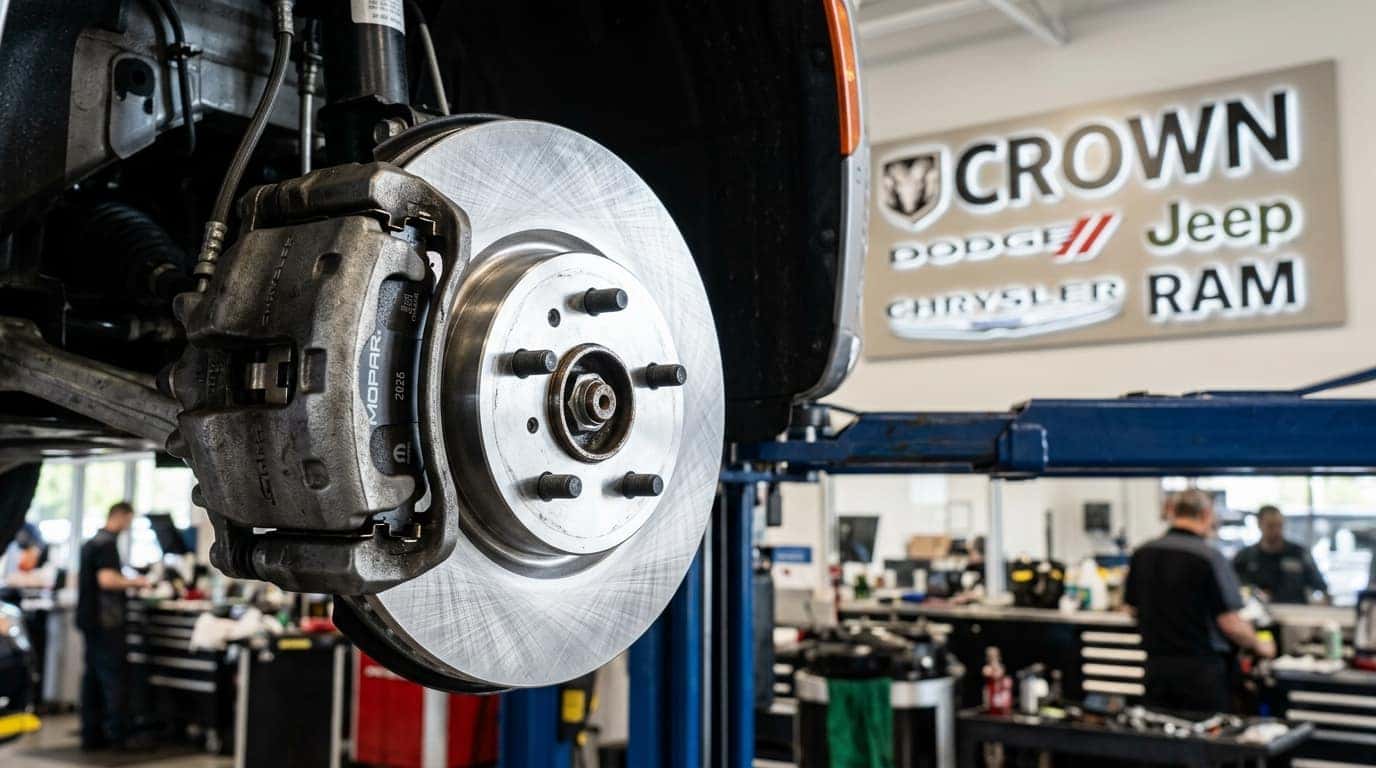
Most Chrysler vehicles require a visual brake inspection every 10,000 to 15,000 miles or at least once per year during routine oil changes and tire rotations. Brake friction pads typically last between 30,000 and 70,000 miles depending on driving habits, while hydraulic brake fluid requires a complete system flush every 24,000 to 30,000 miles or every two to three years. Commuting in heavy stop-and-go coastal traffic or carrying heavy passenger loads accelerates wear on pad material and rotor surfaces.
The exact service schedule for Chrysler stopping systems depends heavily on vehicle model, weight, and environmental exposure. A minivan like the Chrysler Pacifica carrying full passenger loads experiences higher thermal friction during daily stopping than a lighter sedan. Daily stop-and-go traffic can double or triple pad wear rates compared to steady highway driving. In addition, moisture from coastal air promotes surface rust on exposed iron rotors when vehicles sit parked overnight, creating initial abrasive resistance when first pulling away.
| Component | Standard Inspection Interval | Average Replacement Range |
|---|---|---|
| Front Brake Pads | Every 10,000 miles | 30,000–50,000 miles |
| Rear Brake Pads | Every 10,000 miles | 35,000–60,000 miles |
| Brake Rotors | Every 10,000 miles | 50,000–70,000 miles |
| Brake Fluid | Every 10,000 miles | 24,000–30,000 miles / 2–3 Years |
Drivers can monitor several key operational indicators that signal the need for an immediate mechanical evaluation before scheduled service intervals:
- Squealing or high-pitched screeching caused by built-in metallic wear sensors contacting the rotor disc.
- Harsh grinding noises indicating complete friction material depletion and destructive metal-to-metal contact.
- Steering wheel flutter or pedal pulsation while slowing from highway speeds due to rotor thickness variation.
- Increased brake pedal travel or a spongy pedal feel caused by hydraulic fluid contamination or air entrapment.
- Mechanical vehicle pulling to one side under braking pressure from a sticking caliper piston or slide pin.
Maintaining routine stopping power requires immediate attention when these symptoms appear. Drivers navigating daily routes near our Ventura service location address can keep their braking systems in top condition by contacting our technicians or giving our service counter a quick call at (805) 918-4486 to verify component health.
Table of Contents
- What Is Included in a Complete Chrysler Brake Inspection?
- How Often Should Brake Fluid Be Changed in a Chrysler Vehicle?
- Are OEM Chrysler Brake Pads Better Than Aftermarket Parts, and Do They Affect Your Warranty?
- How Much Does Chrysler Brake Pad and Rotor Replacement Cost, and How Long Does It Take?
- Common Questions About Chrysler Brake Maintenance
- Where Can You Get Certified Chrysler Brake Service in Ventura, California?
What Is Included in a Complete Chrysler Brake Inspection?
A complete Chrysler brake inspection evaluates the entire mechanical and hydraulic braking assembly, including friction pad lining thickness, rotor surface integrity, caliper hardware movement, hydraulic line integrity, and electronic module diagnostics. Technicians measure pad lining with specialized precision gauges and check rotors for lateral runout and minimum thickness against factory tolerances. The evaluation also verifies fluid moisture levels, inspects rubber flexible hoses for cracks or swelling, and confirms proper electronic parking brake engagement.
During a professional multi-point brake evaluation, technicians remove all four wheels to gain full visual and physical access to underlying stopping components. Measuring pad thickness ensures the remaining friction material sits safely above the minimum 3 mm safety threshold. Rotors are examined using digital micrometers to confirm disc thickness exceeds the cast-in minimum discard spec and that surface scoring or thermal heat checking has not compromised structural density.
| Complete Chrysler Brake System Inspection Procedure |
| ├── Mechanical Assembly Evaluation |
| │ ├── Precision measurement of front & rear brake pad thickness |
| │ ├── Micrometer check for rotor thickness & lateral runout |
| │ └── Inspection of caliper pistons, boots, & slide pin lubrication |
| ├── Hydraulic System Verification |
| │ ├── Digital moisture percentage test of DOT 3 / DOT 4 fluid |
| │ ├── Pressure & visual leak check of brake lines & fittings |
| │ └── Master cylinder reservoir & cap seal verification |
| └── Electronic & Auxiliary Controls |
| ├── Diagnostic scan of ABS & Electronic Stability Control modules |
| └── Functional test of Electronic Parking Brake actuator motors |
Hardware lubrication and cleanliness play an equally vital role in braking performance. Technicians clean caliper mounting brackets, remove accumulated brake dust, and apply high-temperature synthetic lubricant to stainless steel slide pins and pad abutment clips. Unlubricated hardware can cause pads to bind inside the bracket, leading to uneven pad wear, dragged friction linings, and premature rotor overheating.
Electronic diagnostics conclude the inspection process. Utilizing dedicated factory diagnostic tools, technicians interface with the anti-lock braking system (ABS) and electronic stability control (ESC) computer modules to clear stored fault codes and verify actuator calibration. To arrange a thorough system evaluation, drivers can utilize our convenient online service scheduling portal to select a time that fits their calendar.
How Often Should Brake Fluid Be Changed in a Chrysler Vehicle?
Chrysler factory maintenance specifications state that brake fluid should be flushed and replaced every two to three years or every 24,000 to 30,000 miles. Glycol-based DOT 3 and DOT 4 hydraulic fluids are hygroscopic, meaning they naturally absorb moisture through microscopic pores in flexible rubber brake hoses and reservoir seals over time. Accumulated water degrades thermal resistance, lowers fluid boiling points, and accelerates internal corrosion inside aluminum master cylinders and steel brake lines.
Operating a vehicle in humid coastal plain environments like Oxnard increases the rate of ambient moisture absorption into hydraulic lines. Fresh brake fluid features a dry boiling point exceeding 400 degrees Fahrenheit, allowing it to withstand extreme hydraulic pressures and thermal energy generated during repeated hard stops. As water content rises toward 3 percent or 4 percent, the fluid’s wet boiling point drops significantly toward 280 degrees Fahrenheit. Under heavy braking, this absorbed water vaporizes into steam pockets, creating an compressible gas bubble that results in a soft pedal and severe loss of hydraulic pressure.
| Fluid Condition | Water Content | Estimated Boiling Point | System Risk Level |
|---|---|---|---|
| Fresh Fluid | Under 1% | 400°F+ (DOT 3) / 446°F+ (DOT 4) | Optimal stopping safety |
| Marginal Fluid | 2% to 3% | 300°F to 320°F | Elevated pedal spongy feeling |
| Contaminated Fluid | Over 3.5% | Below 280°F | Critical fluid boil & failure risk |
A complete hydraulic flush replaces oxidized, dark fluid with clean, clear fluid across all four wheel circuits. Technicians connect pressure bleeding equipment to force out trapped air bubbles, dissolved rubber particulates, and suspended copper ions that degrade internal anti-lock braking system valves. Regular fluid exchanges preserve sensitive hydraulic control units and ensure firm pedal response during emergency deceleration.
Are OEM Chrysler Brake Pads Better Than Aftermarket Parts, and Do They Affect Your Warranty?
Factory original equipment manufacturer (OEM) Chrysler brake pads engineered by Mopar provide exact dimensional fitment, vehicle-specific friction formulations, and factory-validated noise and vibration dampening. Aftermarket friction pads utilize generic multi-fit backplates and standardized compound mixes that may alter pedal feel, generate higher dust volumes, or create persistent brake squeal. Under the federal Magnuson-Moss Warranty Act, installing aftermarket brake pads does not void your overall Chrysler vehicle warranty unless the non-OEM part directly causes mechanical failure in adjacent system components.
Engineers design factory Mopar brake pads specifically for the gross vehicle weight rating, rotor diameter, and caliper piston area of each individual Chrysler platform. Premium ceramic and semi-metallic formulations undergo extensive thermal cycling tests to guarantee consistent pedal feedback across variable temperature ranges. Furthermore, factory pads come pre-fitted with rubberized multi-layer steel shims designed to eliminate high-frequency squealing without requiring temporary anti-squeal pastes.
| Feature | OEM Mopar Pads | Generic Aftermarket |
|---|---|---|
| Friction Compound | Vehicle-Specific | Universal Multi-Fit |
| NVH Shim Dampening | Factory Steel Shims | Glue-On or Omitted |
| Backplate Tolerance | Exact OEM Spec | Stamped Variable Fits |
| Dust Production | Low Ceramic Dust | Variable / Often High |
| Warranty Protection | Preserved / Supported | Subject to Component Damage |
Warranty protections remain intact when maintaining stopping hardware with approved parts and certified labor. While third-party friction materials are legal for road use, selecting lower-quality alternatives carries operational trade-offs:
- Harder aftermarket semi-metallic compounds can increase rotor surface wear, causing early grooving and disc replacement.
- Loose-fitting backplates can rattle inside caliper brackets when driving over rough road seams.
- Incompatible friction compounds can leave uneven resin deposits across the rotor face, inducing steering wheel vibration.
- Substandard backing plate coatings can rust rapidly, causing pad friction material to separate from the steel plate.
Choosing factory-approved hardware preserves original braking dynamics and component longevity. Owners looking to maintain factory specification standards can source certified components directly through our genuine Mopar brake components and accessories department.
How Much Does Chrysler Brake Pad and Rotor Replacement Cost, and How Long Does It Take?
Replacing both brake pads and rotors on a Chrysler vehicle generally costs between $350 and $650 per axle depending on the platform, rotor size, and specific trim specification. A standard pad and rotor replacement completed by experienced technicians typically takes one to two hours per axle. Total service time may expand if hydraulic fluid flushing, caliper slider rebuilding, or electronic actuator servicing is required.
Front braking components carry higher replacement costs than rear components because front brakes absorb up to 70 percent of a vehicle’s stopping weight, requiring larger iron rotors and higher-density friction pads. While resurfacing or turning rotors on a brake lathe was common practice on older vehicles, modern lightweight rotor designs leave thinner discard margins. Replacing worn rotors with new units ensures proper thermal mass and eliminates structural warping risks.
| [0:00 – 0:15] | Wheel removal, vehicle hoisting, & preliminary caliper check |
| [0:15 – 0:45] | Caliper disassembly, rotor removal, & hub surface cleaning |
| [0:45 – 1:15] | Electronic EPB service mode retraction & piston compression |
| [1:15 – 1:45] | New rotor mounting, hardware lubrication, & pad installation |
| [1:45 – 2:00] | Torque check, wheel mounting, & post-service road bed-in test |
Modern braking platforms equipped with an electronic parking brake (EPB) require specific diagnostic steps during rear pad service. When drivers ask about rear brake maintenance on Pacifica minivans, our team explains how the electronic parking brake must be electronically retracted into service mode using a diagnostic tool before caliper pistons are compressed. Forcing rear pistons backward without retracting the internal motor gear destroys the caliper assembly, adding substantial repair costs.
Following physical installation, technicians execute a controlled pad bed-in procedure. Performing several moderate decelerations from 40 mph down to 10 mph transfers an even, microscopic layer of friction material from the new pad onto the fresh rotor surface. This chemical transfer layer prevents direct metal-on-metal abrasion, stops surface glazing, and establishes quiet, powerful stopping action right from the service bay.
Common Questions About Chrysler Brake Maintenance
Q: How does the electronic parking brake work on Chrysler vehicles?
A: The Chrysler electronic parking brake replaces traditional floor pedals and hand levers with electric actuator motors mounted directly on the rear caliper housings. Pressing the console switch signals these bi-directional electric motors to turn an internal gear assembly, pushing the caliper piston forward to lock the rear brake pads firmly against the rotors. Releasing the switch reverses motor rotation, backing the piston off to allow smooth wheel movement.
Q: Why do Chrysler brakes squeak when coming to a stop?
A: Brake squeaking usually occurs when pad friction lining wears down to a built-in metallic indicator clip, which scratches against the rotor face to alert the driver of thin pad material. Morning humidity can also create a light layer of flash rust on cast-iron rotors that squeaks briefly during the first few stops. Persistent squealing on newer pads indicates unlubricated caliper slide pins, missing anti-rattle clips, or glazed friction material from hard stopping.
Q: Can worn brake rotors cause steering wheel vibration during braking?
A: Worn or thermally stressed brake rotors develop thickness variation across their friction surfaces, commonly referred to as rotor warping. When the brake pads squeeze against a disc with uneven high and low spots at highway speeds, hydraulic pressure pulses rapidly through the brake lines. This pulsation travels up through the steering rack, causing noticeable shaking or vibration in the steering wheel during deceleration.
Q: Do Chrysler Pacifica Hybrid models wear out brake pads at the same rate as gasoline models?
A: Chrysler Pacifica Hybrid models generally experience slower mechanical brake pad wear than standard gasoline models because of regenerative braking. When the driver presses the brake pedal, the hybrid system first uses the electric drive motor as a generator to slow the vehicle while harvesting kinetic energy to charge the high-voltage battery. The mechanical friction pads only engage during hard emergency stops or at speeds below 5 mph, extending pad lifespan.
Q: What causes a soft or spongy brake pedal feel in a Chrysler vehicle?
A: A soft or spongy brake pedal indicates air bubbles trapped inside the hydraulic lines or high moisture contamination within the brake fluid. Because air and water vapor compress under pressure while hydraulic fluid does not, energy meant for the calipers gets absorbed by compressing gas pockets. Flushing the hydraulic lines with fresh fluid restores firm pedal feel and immediate hydraulic response.
Where Can You Get Certified Chrysler Brake Service in Ventura, California?
Certified Chrysler brake service in Ventura is available at Crown Dodge Chrysler Jeep RAM, located at 6300 King Dr, Ventura, CA 93003. Our factory-authorized facility utilizes factory-trained technicians, Mopar special service tools, and genuine original equipment replacement parts designed specifically for your vehicle. Whether your car requires a simple safety inspection, new ceramic pads, or a complete hydraulic fluid flush, our team delivers complete stopping care tailored to local driving conditions.
Navigating steep mountain terrain puts elevated demands on vehicle deceleration systems. Commuters driving down the steep Conejo Grade from Camarillo exert heavy friction and thermal load on front stopping hardware, making routine factory inspections essential for driving safety. Regular checks prevent heat checking, pad glazing, and fluid overheating caused by prolonged downhill braking.
| Why Choose Certified Mopar Brake Service? |
| ├── Factory-Trained & ASE-Certified Technicians |
| ├── Genuine Mopar Brake Pads, Rotors, & Hydraulic Fluids |
| ├── Advanced Electronic Diagnostic Tools for ABS, ESC, & EPB Systems |
| ├── Specialized On-Site Brake Lathes for Precision Rotor Care |
| └── Full Factory Warranty Coverage & Nationwide Protection |
Choosing authorized dealership care keeps your vehicle operating according to factory safety guidelines. Our service center offers comfortable customer amenities, transparent multi-point inspection reports, and flexible scheduling windows designed for busy routines.
Maintain complete confidence on every journey by taking care of your braking hardware before friction materials wear out. Drivers ready to inspect or renew their stopping components can navigate to our Ventura showroom and service center location or speak directly with an advisor by giving our dedicated line a quick call at (805) 918-4486 to reserve a convenient service appointment today.
© 2026 Crown Dodge Chrysler Jeep RAM. All rights reserved.
0 comment(s) so far on How Often Does a Chrysler Vehicle Need Brake Service?